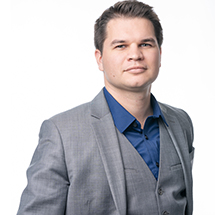
Stephen Parker (Stantec)
In this series, Healthcare Design asks leading healthcare design professionals, firms, and owners to tell us what has their attention and share their ideas on the subject.
Stephen Parker is an architect and mental and behavioral health SME leading projects around the globe with Stantec Architecture (Washington, DC.). Here, Parker shares his thoughts on the evolution of behavioral health design using sensory-enabled architecture, expanded emergency psychiatric care options, and trauma-informed strategies.
1. Sensory-enabled architecture
Neuroinclusive design is having a moment across healthcare, evolving beyond singular sensory rooms in psychiatric settings to be more inclusive of general healthcare spaces, educational facilities, workspaces, and other typologies. Increasing awareness that we all have diverse sensory needs is driving this growth.
We can all benefit from immersive, experiential environments that are neuroinclusive—not just accommodating but inclusive of different ways of seeing and processing reality. From children on the spectrum to patients in an altered mental state or heavily medicated, all patients can benefit from integrating a more holistic, neuroinclusive approach.

2. Expanding emergency behavioral health
There’s been a surge of crisis centers, EmPATH units, and psychiatric emergency departments across North America. This growth is expected to continue as the Substance Abuse and Mental Health Services Administration – (SAMSHA; Rockville, Md.), the federal agency leading behavioral health policy – better defines care settings for the range of crisis services that differ from community to community.
As these models of care evolve rapidly, architecture firms are realizing the benefits of thoughtful planning on the location of intake spaces, distinct separation of patient flows, and trauma-informed models that peer support staff can operationalize.
More robust national—SAMSHA and Facility Guidelines Institute (FGI)—and statewide licensing for crisis centers is leading to better understanding of how these policies and staffing impact space utilization. Fundamentally different behavioral health projects are the result of overcoming the intake challenges of “no-wrong-door” facilities—meaning no patient is refused service for lack of insurance, legal status, or other exclusionary criteria—as well as integrating peer support staffing.
Peer support staff have lived experience to draw upon and are out and about in the milieu, meaning the traditional approach to staff stations is evolving from enclosed to more open touch-down areas. Efficient planning for understaffed crisis units can make or break the proforma of operational budgets and make the difference in crafting a safe yet serene environment of care.
3. Evolving medical psychiatry environments
Complex Medical Units (CMUs, also known as med/psych units) are getting their own section in the 2026 FGI Guidelines for Design and Construction, reflecting the increasing complexity of patients with dual diagnosis of both behavioral health and medical issues.
The design of such units should prioritize the well-being, safety, and comfort of complex patients with better headwall enclosures and patient rooms that can safely accommodate longer stays for scheduled detox or recovery from eating disorders or geropsychiatric conditions.
As more units come onboard in the U.S., with many more abroad, it’s important for the design community to share lessons learned across borders to help accelerate this trend in CMUs that support, nurture, and empower patients and their loved ones throughout their recovery journey.
4. Addressing generational trauma in Indigenous communities
Trauma-informed design plays a significant role in addressing the complex, intergenerational behavioral health issues of tight-knit Indigenous communities. Aqqusariaq, the Nunavut Recovery Centre in Iqaluit, Nunavut, Canada, is built on a model of care is “Made in Nunavut” and developed for all Nunavummiut. This is a prime example of an inpatient facility designed for entire families to be treated holistically in this community of 40,000 people.
Design can respond to the trauma experienced by individuals and communities—promoting safety, voice, choice, and trustworthiness by providing spaces for patients to engage socially if they choose as well as accommodating traditional arts, culinary, and spiritual practices integral to their therapy. This approach helps avoid coercion, confinement, and re-traumatization through spatial design.
5. Advocating for maternal mental health
Severe mental health issues are one of the leading causes of complications during pregnancy and childbirth. Many parts of the country lack appropriate facilities to address these needs.
For example, Women’s Hospital – Perinatal Mental Health Unit in Baton Rouge, La., prioritizes the mental health of new and expecting mothers. This project includes private mother-baby suites, post-partum care in a safe and serene care setting, and access to private therapy gardens.
Want to share your Top 5? Contact Senior Editor Robert McCune at [email protected] for submission instructions.