Project category: New construction
Chief administrator: Mary Ockenden, associate vice president & director of space planning, University of Rochester Medical Center
Firm: Ballinger, www.ballinger.com

Project category: New construction
Chief administrator: Mary Ockenden, associate vice president & director of space planning, University of Rochester Medical Center
Firm: Ballinger, www.ballinger.com
Pioneering projects get a lot of press when they first open, becoming the touchstone and inspiration for the design of other projects. After we explore the cutting edge, perhaps it’s even more important to understand how a project has performed after years of use—the consequences, intended and unintended, of design.
After years of consideration, the Centers for Medicare & Medicaid Services (CMS) and the Joint Commission have adopted the 2012 edition of NFPA 101: Life Safety Code, effective July 5, 2016.
Many people are talking about the changes happening in the healthcare industry and how they could affect building design and construction. I hear at least one presentation on the topic at every program I attend. In our quest to stay ahead of major shifts that could alter how we do business, we’re constantly looking to experts to predict the future so we can skate to where the puck is going and not to where it currently is.
With lighting equipment accounting for a good portion of a project’s FF&E costs, budget frequently drives healthcare lighting programs. At the same time, healthcare organizations realize that successful designs can pay off.
Today, a hospital is no longer seen as a destination for the sick. Health systems across the U.S. are transforming their campuses into community hubs for health and wellness. At the same time, healthcare is increasingly delivered in community settings such as schools or homes, where patients are empowered to manage and improve their own health.
The patient room is one of the better-researched areas of an acute care facility, and because of that it’s one of the easiest places to incorporate thoughtful evidence-based design (EBD) features.
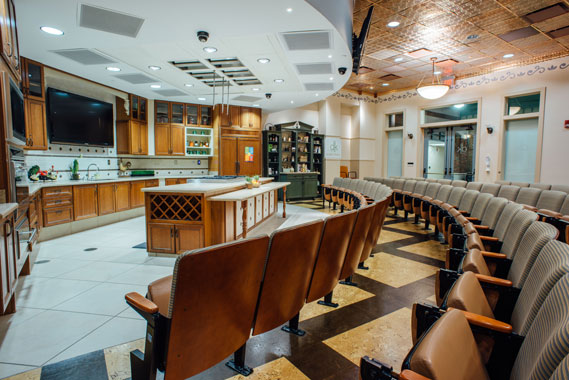
As a hands-on way to encourage wellness, more and more health systems are on a mission to show and tell their communities how to eat well. Introducing demonstration kitchens, some with mini-auditoriums, has become an innovative way for hospitals to engage the public in disease prevention and management.
Traditionally when people have thought of a healthcare facility, they’ve envisioned an uninviting environment where you go when you’re sick. But health facilities are working hard to change that image as they promote healthy lifestyles.
Today, health systems are beginning to focus more on becoming wellness destinations—convenient places that the public wants to visit to proactively manage their health.

The recent outbreak of Ebola in parts of West Africa put in focus the lack of a coherent strategy for addressing infectious disease outbreaks, as fear and confusion around the crisis resulted in many potentially preventable deaths.
I recently read an article on the future of the lighting business and it made me think about our own industry and the path we’re on.
Thomas Edison invented the first commercially successful light bulb in 1879. Since that time, the technology behind the light bulb continues to be refined and improved. But it’s only been in the last few decades, as a push for reduced energy usage became significantly more important, that large leaps forward were made.
The Family Health Center Inc. (FHC) is a non-profit healthcare provider that was established in 1976 with seven locations throughout the Louisville, Ky., metro area. It now serves more than 37,000 patients annually, without regard to the ability to pay.