HCD Guest Author

HCD Guest Author's Latest Posts

New Terrain: Designing Outdoor Rehab Spaces

Most of us take for granted the surfaces we walk on each day and our ability to get from one location to another. But for many rehabilitation patients—many of whom have undergone a dramatic change in the way they live daily life—each surface is now an obstacle course.

Due to that fact, a growing and critical part of their rehabilitation is taking place outside hospital walls, in terrain parks and agility courses designed to both challenge and aid patients in regaining independence.
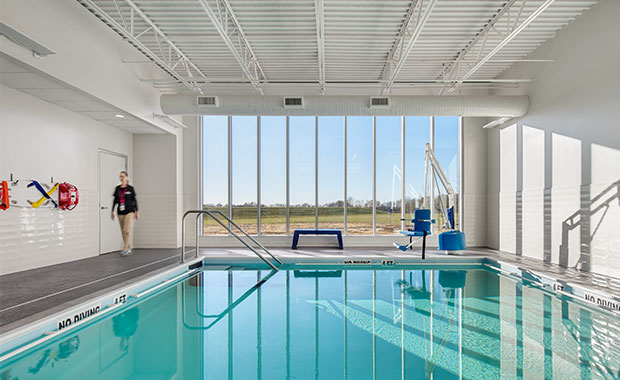
Rehabilitation Care: Preparing For The Future

Strategically planned bed growth in rehabilitation care is primarily being inspired by meeting the needs of baby boomers and beyond. On the inpatient side, emphasis on single-occupancy post-acute rooms is expected to continue, says Brenna Costello, principal and medical planner with SmithGroupJJR. However, it’s not just the size of that patient population and age-related ailments that are pushing growth.

The Intersection Of Healthcare And Politics

Since passage of the Affordable Care Act (ACA) in 2010, politics and healthcare have taken center stage in a national discussion. Some have considered the ACA government intrusion; others find it to be necessary reform to achieve better population health.

Yet this fusion of politics and healthcare is nothing new. The federal and state governments have been involved in healthcare since the founding of our country.

Best Practices For Rehab Center Design

Best Practices For Rehab Center Design

Today’s rehabilitation spaces are designed to be motivating, welcoming, safe, and accessible. Everything from the layout and equipment to a mix of open and private areas are created with an eye on contributing to and promoting accomplishment and inspiration.

New Health Systems Call For New Building Types

Serving as a juror for the annual Healthcare Design Showcase this past year, I saw several submissions that contained a host of excellent work related to hospitals and traditional health facilities. A number of other entries, however, captured a category not seen at this scale before: the multispecialty ambulatory facility.

Freestanding EDs: The New Hospital Front Door

One of the newest programs and building types being developed within the healthcare industry is the freestanding emergency department (FSED). These projects are growing in popularity as hospitals and healthcare systems strategize ways to provide improved, responsive care in the most cost-effective physical environment possible.

Precautionary Tale: A Detailed Approach To Biocontainment Unit Design

In 2004, as part of nationally coordinated antiterrorism efforts, Nebraska Medicine brought online a first-of-its-kind unit for the safe treatment of deadly infectious diseases. Early involvement of frontline staff with the design team of Leo A Daly was crucial to creating a unit that met the complex safety, operational, and psychological needs of clinicians working in this challenging environment.

Listen Up: Surveying Patients To Shape Better Designs

Sometimes the best ideas are the most obvious. For example, if you want to make cancer patients comfortable during treatments, ask them how.  

When designing cancer facilities, architects must keep the physical, psychological, and emotional needs of patients at the forefront of their process. To help guide this, Francis Cauffman’s design team surveys cancer survivors about their experience with treatment and the environment in which they receive care.

Tackling The Transition To The New Parkland

In 2008, leadership at Parkland Hospital in Dallas realized that the facility built in 1954 had reached its useful life and it was time to embrace the future. So began a journey that lasted nine years. The new $1.3 billion, 2.1 million-square-foot New Parkland Hospital broke ground in 2010 and opened to the public on Aug. 20, 2015. What did it take to move staff, patients, and equipment literally across a highway from old location to new? An extreme amount of planning, persistence, and patience.

Strategy & Planning Series