
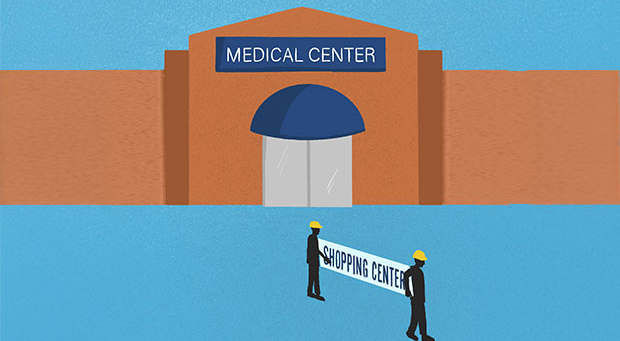
Multispecialty medical malls
- A projected decline in MOB construction is driving healthcare owners and developers to look at retail conversions to deliver new outpatient facilities.
- Contemporary medical malls typically comprise conversions of former big-box retail facilities, supermarkets, and shopping centers.
- Repurposing retail spaces for healthcare requires intentional design to meet strict regulatory, accessibility, and infection-control standards.
Medical office building construction is projected to decline 26 percent by 2026, reaching the lowest level in over a decade, according to the report “U.S. Healthcare Real Estate: 6 Key Trends to Watch in 2026,” by commercial real estate services and investment firm CBRE (Dallas), published in December 2025.
Across the healthcare sector, healthcare owners and developers are increasingly turning to retail conversions. Driven by rising construction costs, prolonged development timelines, and a systemic shift away from large campus models toward decentralized care, adaptive reuse offers a practical alternative to ground-up development.
Former retail spaces, now frequently reimagined as multispecialty “medical malls,” present unique design and operational advantages for outpatient services. These readily available facilities are typically situated in high-traffic, community-facing locations with ample parking and built-in accessibility, providing an ideal framework for delivering modern, patient-centered healthcare.
What is a medical mall?
Contemporary medical malls typically comprise conversions of former big-box retail facilities, supermarkets, and shopping centers. These projects feature leasing structures that consolidate large groups of practitioners, from primary care physicians to urgent care providers, alongside specialists including cardiologists, neurologists, OB/GYNs, and oncologists.

Additionally, medical malls often include support services such as imaging and laboratory testing, bringing multiple specialties under one roof.
However, repurposing retail spaces for healthcare requires intentional design. Project teams must navigate unique layout and infrastructure challenges while meeting strict regulatory, accessibility, and infection-control standards.
Long-term operational and financial success relies on thorough site evaluations, infrastructure feasibility assessments, and early alignment among key stakeholders, including health system leaders, real estate and development partners, design/construction teams, and clinicians.
When executed effectively, this approach delivers operational and care improvements.
Patients enjoy streamlined administrative services and reduced travel times, while providers reap rewards in scheduling efficiency, optimized resource allocation, and improved financial performance.
Case studies with Hackensack Meridian Health
Working with Hackensack Meridian Health (HMH; Hackensack, N.J.), architecture firm FCA (Philadelphia) created a hub-and-spoke development strategy using three distinct space typologies (small, medium, and large) dependent upon the property available and the localized clinic demand.
This approach was developed in response to a growing demand for outpatient services and the need for cost-effective solutions to meet projected patient volumes. The goal was to streamline speed to market with more flexible, economical prototypes for growth.
The result is a repeatable sequence of design cues and best practices that can be adapted across sites while still responding to the needs of providers and their communities.
For the Hackensack Meridian Health & Wellness Center in Eatontown, N.J., opened in September 2022, the project team renovated two former retail facilities: a vacant DSW and adjacent Toys “R” Us. FCA worked with HMH to deliver a 45,000-square-foot outpatient facility with centralized urgent care services and access to 36 flexible exam rooms. The location also includes primary care and cardiology, as well as imaging, neurology, rehabilitation, women’s oncology, and dedicated lab services.
The existing buildings provided several benefits: an existing loading dock for back-of-house delivery and logistics support, an exterior that required minimal architectural intervention, ample parking space, and an existing slab that could be modified where necessary to reduce costs without the need for extensive demolition or reconstruction. This allowed for the reconfiguration of layouts and structural requirements with minimal adjustment.
Despite these positives, complex retrofitting was necessary to align the site’s overall infrastructure with needs for plumbing and drainage, such as a handwashing station in each exam room, as well as upgraded electrical capacity. Ultimately, the project provided the building blocks for the team to refine its approach to multispecialty layouts, shared administrative areas, and budget-conscious reuse of existing structural elements where possible.
These findings were applied to future projects, including the Hackensack Meridian Health & Wellness Center at Clark. Opened in 2024, this project, which leaned heavily on the design and layout of the Eatontown project, converted a 30,000-square-foot Barnes & Noble bookstore in Clark, N.J., to a health center, which co-locates a multispecialty practice suite alongside an urgent care, physical and occupational therapy, imaging services, OB/GYN, and a small lab.
Site conditions played a major role in differentiating this project from its predecessor. Among the features were a wide and shallow floor plate, primed for a single-level layout with easier mechanical/electrical integration, and strong frontage along two roads to enhance community engagement and visibility.
Additionally, 16-foot ceiling heights could accommodate medical equipment and lighting requirements without major structural modification.
Still, no conversion of this type is without challenges. After the need to conduct historical deed research to determine former uses, findings showed that a portion of the site had previously been used as a construction dump.
Uncompacted construction debris had to be removed at the site to create a stable foundation for updated infrastructure. The project also required substantial exterior work to facilitate ramps, rebuild both stairs, and improve access to loading docks.
Strategies for site selection in healthcare renovations
Alignment on real estate and infrastructure vetting during early project stages are important steps in retail-to-medical conversions.
- First, designers and health system leaders should consider the site’s relation to the surrounding community.
- Corner locations that feature dual frontage allow projects to integrate more seamlessly into the surrounding environment, while also greatly increasing visibility.
- The excess of windows in these types of spaces further allows for more natural light to penetrate the space, improving patient experience overall.
- Moving beyond the site, infrastructure readiness is another important consideration of a space’s overall feasibility for conversion.
- Electrical systems must have sufficient capacity to support energy-intensive medical equipment such as imaging machines and laboratory equipment.
- Plumbing systems should be capable of handling multiple exam rooms with sinks or other specialized fixtures, with appropriately sized sewer lines for wastewater from clinical activity.
In some cases, teams can address inadequacies in these areas through targeted interventions—adding dedicated circuits and sewer connections and designing layouts to rework utilities without compromising experience. Early feasibility testing is crucial to avoid delays and manage project budgets to maximize the advantages associated with these conversions. Logistics, from off-stage areas such as existing loading docks to adequate parking/EV charging capabilities, are also critical components for a successful medical mall conversion.
How can medical malls address healthcare access needs?
As access to healthcare remains an issue across the United States, medical mall conversions serve as a viable option to address growing care needs. The success of these conversions relies heavily on thoughtful real estate selection, planning, and physician alignment through each phase.
Health systems that treat medical malls as part of their overarching outpatient infrastructure strategy, as opposed to opportunistic real estate moves, will be positioned to succeed in the long term.
Aran McCarthy, AIA, NCARB, is president of FCA (Philadelphia) and can be reached at [email protected].