The 2026 Healthcare Design Conference + Expo, to be held Oct. 17-20 in New Orleans, will host more than 100 keynote and educational sessions on a variety of topics.
Healthcare Design is previewing some of the upcoming educational sessions in a series of Q+As with speakers, sharing what they plan to discuss and key takeaways they’ll offer attendees.
Session: E33 – “Unified Spaces, Unified Care: Designing Community-based Public Health Campuses for Integrated, Equitable Care”
Sunday, Oct. 18, 2-3 p.m.

Speaker: Debbie Beck, principal, heath care strategy/planning executive, Perkins&Will (Dallas); Jerry Johnson, design principal, Perkins&Will (Chicago); Todd Accardi, director of medical planning, Perkins&Will (Chicago); Lydia Travis, planning & strategy lead for facilities management, Johnson County (Olathe, Kan.)
As communities confront rising behavioral health demand, workforce shortages, and widening health inequities, public health facilities must evolve from siloed service buildings into integrated, community-centered care hubs.
This session will examine how Perkins&Will, in partnership with Johnson County, Kan., designed a 130,000-square-foot integrated health services building that colocates mental health, public health, and aging services. It will also explore Public Health 3.0, a collaborative, equity-focused model where public health leaders work across sectors to improve community health by tackling root causes, not just disease.
Speakers will share transferable design and planning strategies for public-sector and community-based healthcare projects, showing how architecture can strengthen public health delivery, reduce barriers to care, and prepare facilities for the future amid changing community needs.
Healthcare Design: How has the role of public health facilities evolved over the past five years?

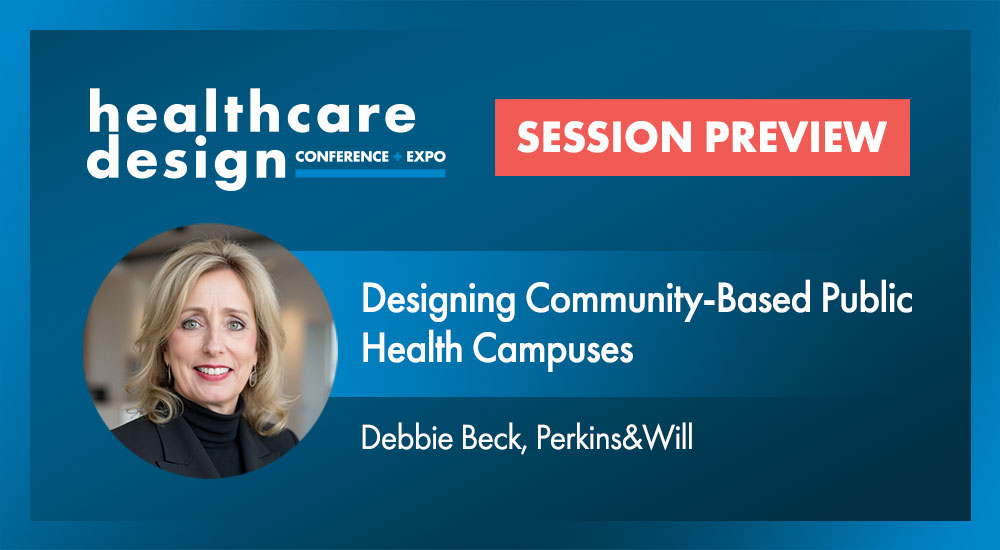
Debbie Beck (Image credit: Courtesy of Perkins&Will)
Debbie Beck: Public health is moving toward a more connected, community-focused model. That approach often brings physical health, behavioral health, prevention, aging, and social services together, making it easier for people to access the right support in one place.
Johnson County used Public Health 3.0 as its vision, bringing services, partners, and resources together to address the broader factors that influence health and well-being.
HCD: What is Public Health 3.0? And how did the project team use it to design for care that works across disciplines, not just services that share an address?
Beck: Public Health 3.0 is about collaboration across disciplines, not simply colocation. For Johnson County, that meant designing the building around shared resources, connections between teams, and the patient/client journey so mental health, health and environment, and aging and human services could function as a coordinated system.
HCD: Rural and underserved communities face real barriers to accessing care. What design strategies can make the biggest impact?
Beck: Design can help by creating a single welcoming point of access, colocating services so people can address multiple needs in one visit, using clear wayfinding and intuitive circulation, providing flexible rooms that support different services, and creating shared community rooms that can support education, outreach, and partnerships. The goal is to make care easier to reach, easier to navigate, and easier to coordinate.
HCD: What are the most important considerations for community-centered care hubs?
Beck: The facility must be designed for the community’s needs today, but also for needs we cannot fully predict. This includes planning and designing flexible rooms, shared resources, adaptable infrastructure, and spaces that can support different services over time. Public Health 3.0 reinforces the importance of flexibility, shared resources, partnerships, and spaces that can evolve as populations, services, technology, and care models change.
HCD: What’s one takeaway from your session that you want attendees to remember?
Beck: Johnson County demonstrates how the built environment can help turn separate public services into a more connected system focused on the health of the whole community.
Integration is more than putting services under one roof. When we intentionally design around people, relationships, and how care is actually delivered, the building can become part of the solution, improving access, collaboration, and community health.
Find updates and additional information on the 2026 HCD Conference + Expo here.