The 2026 Healthcare Design Conference + Expo, to be held Oct. 17-20 in New Orleans, will host more than 100 keynote and educational sessions on a variety of topics.
Healthcare Design is previewing some of the upcoming educational sessions in a series of Q+As with speakers, sharing what they plan to discuss and key takeaways they’ll offer attendees.
Session: E99 – “All-Electric Healthcare Facilities: Lessons from the MD Anderson Cancer Center”
Tuesday, Oct. 20, 2:30-3:30 p.m.

Speaker: Joss Hurford, building performance consultant, Affiliated Engineers, Inc. (AEI; Madison, Wis.); Greg Norris, director of energy and utility programs, The University of Texas MD Anderson Cancer Center (Houston); Kwongyee Yeong, principal, AEI (Austin, Texas)
Healthcare systems face pressure to reduce carbon emissions without compromising patient care, yet few pursue fully electric facilities. MD Anderson Cancer Center’s campus in Sugar Land, Texas, demonstrates how all-electric design can support decarbonization while maintaining resilience, patient-centered care, and long-term financial performance.
During this session, attendees will learn how MD Anderson extended the principle of “first, do no harm” to the built environment, which shaped envelope performance, system selection, and operational strategies. The session will also explore the business case for electrification, including lifecycle cost analysis, grid-emissions forecasting, risk reduction, and available incentives.
Healthcare Design: What are some of the misconceptions around electrification in healthcare design, and how do they create barriers to implementation?

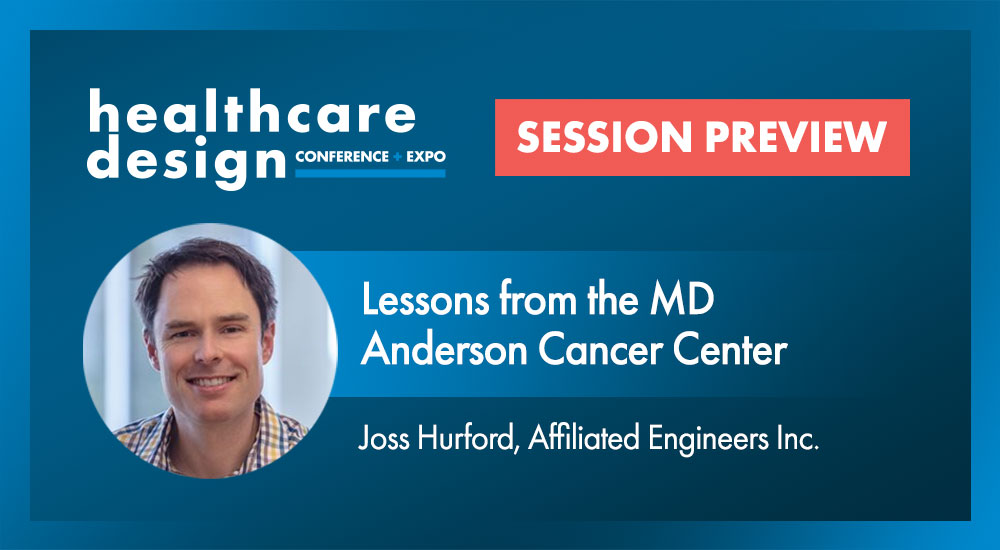
Joss Hurford (Image credit: Affiliated Engineers, Inc.)
Joss Hurford: Common misconceptions are that electrification must be an all-or-nothing approach, is inherently more expensive, or cannot meet the reliability and performance demands of healthcare facilities. These assumptions can cause electrification to be dismissed before proper evaluation.
Electrification in support of decarbonization is a journey and better understood as a flexible, phased approach informed by climate, utility costs, infrastructure, resilience requirements, and long-term organizational goals.
HCD: How has the business case for electrification changed in the past five to 10 years?
Hurford: Electrification was once viewed primarily as a sustainability measure with a cost premium. Today, while economics remain project- and location-specific, it is increasingly a practical life-cycle investment that supports efficiency, carbon reduction, and future readiness.
The business case has become more compelling and now encompasses broader organizational priorities, including regulatory preparedness, market expectations, reputation, and long-term risk management.
HCD: What drove MD Anderson to want to deliver an all-electric design for its Sugar Land campus?
Hurford: MD Anderson recognized the Sugar Land project as an opportunity to translate its broader sustainability and decarbonization goals into a practical design solution.
As a flagship development, the project could demonstrate how an all-electric healthcare facility can support long-term carbon reduction without compromising clinical performance. The design approach and lessons learned can also help inform future projects across the organization.
HCD: What’s one challenge you confronted on this project, and what solutions did you apply to overcome it?
Hurford: One of the central challenges was establishing a compelling business case for the all-electric design early enough to influence fundamental system decisions. The project team conducted a focused options study that combined energy and carbon modeling, contractor pricing, life-cycle cost analysis, and input from key operational stakeholders. This gave MD Anderson leadership a clear view of the costs, benefits, and tradeoffs and allowed the project to move forward with confidence.
HCD: What’s one takeaway from your session that you want attendees to remember?
Hurford: All-electric healthcare design is feasible—and it can be cost-effective—but success depends on making informed decisions early. By aligning leadership, facilities, design, and construction teams around shared goals and evaluating carbon alongside cost, operations, and resilience, project teams can identify win-win strategies and turn decarbonization ambitions into defensible design decisions.
Find updates and additional information on the 2026 HCD Conference + Expo here.